Notes · What we build
Every approved extension in your borough, the week it is granted.
A lead board built for DeWolf Design & Build, a North London design and build firm. It reads the planning register across their boroughs, scores every approved project, and puts the ones worth quoting at the top.
The problem
The work is public. Finding it is the job
Every council publishes the extensions, loft conversions and renovations it approves. For a builder that is a list of people who have just been given permission to spend money on exactly what you do.
The catch is that it arrives as a planning register: thousands of entries, most of them irrelevant, no sense of size, and no order. Reading it properly is a job nobody has time for, so most builders keep working on referral and hope.
What we built
The board
Approved applications across Barnet, Camden, Enfield, Hackney, Haringey and Islington, scored and ranked.
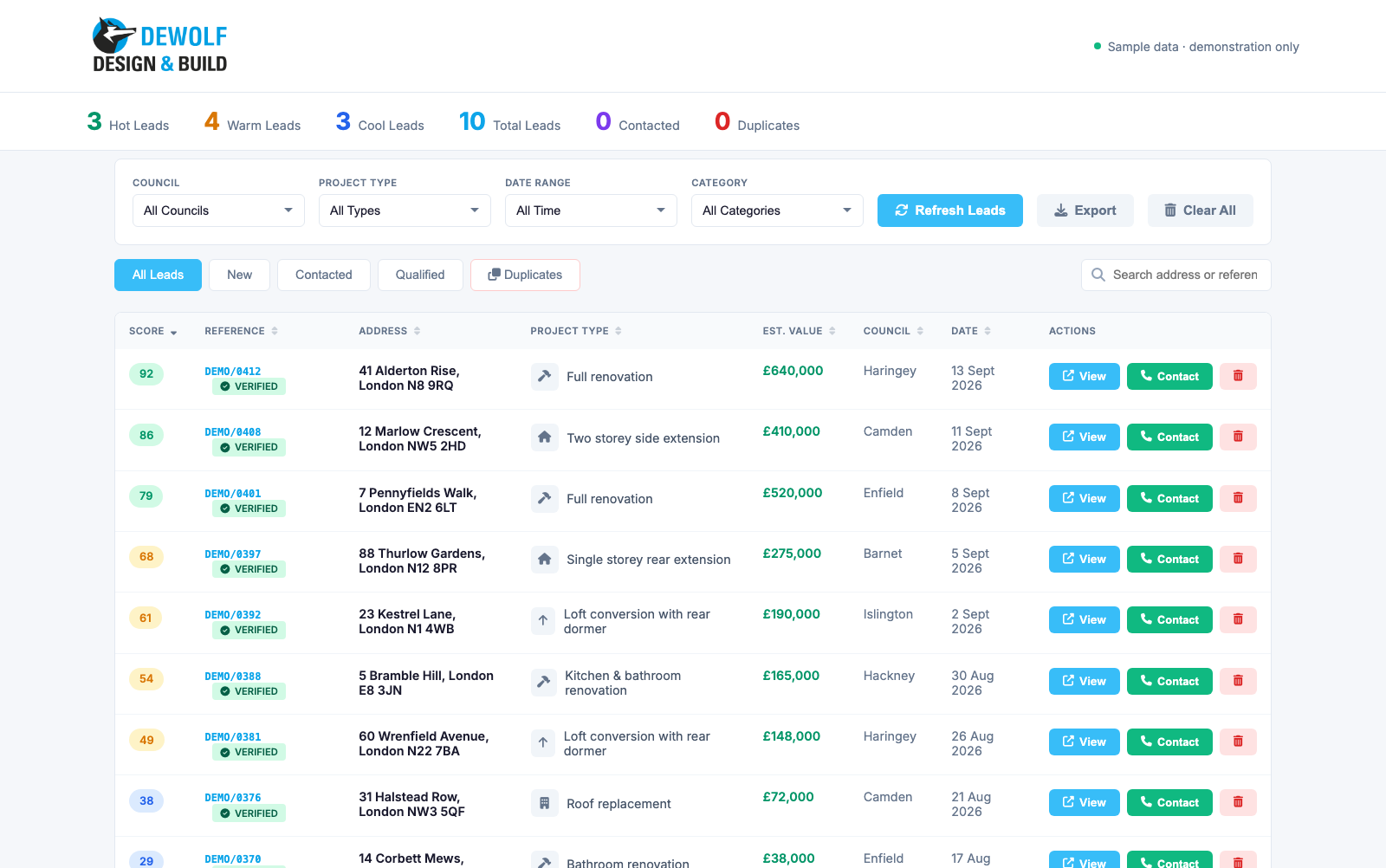
Sample data. Every address, reference and value shown is invented for this illustration.
How it decides
Scoring, and what it is actually weighing
What the job is worth
Estimated project value carries the most weight, because a full renovation and a bathroom refit are not the same opportunity even when both are approved on the same street.
What kind of work it is
A full renovation scores highest, then side and two storey extensions, then rear extensions, then loft conversions. The ranking reflects contract size and how much of it one firm can take on.
Freshness and place
How recently consent was granted, and which authority it sits with, so a board can be worked by borough rather than as one undifferentiated list.
Hot, Warm or Cool
Scores become a band rather than a number to argue with. Duplicate references are flagged, and every row keeps a link back to the public record it came from.
Why it generalises
One method, two different buyers
This is the same engine as our Multi-Unit board, pointed at a different customer. A granted consent for a residential scheme is a lending opportunity to a development finance broker and a building contract to a builder. Same public record, same scoring, entirely different sales conversation.
That is the useful part. The method is not tied to one trade: wherever a public register records the moment someone decides to spend, the same approach applies.
Honestly
What this is, and what it is not
This is a build, not a results story. The board was built and handed over; it has not yet been run as part of DeWolf's day to day sales. So there are no won contracts to report here, and we are not going to imply otherwise.
What it does show is how we approach the problem: read the public record, weigh it, rank it, and give the owner something they can work in ten minutes rather than a spreadsheet nobody opens.
Want this pointed at your market?
Book a call and we will show you what the register already holds for your patch.